
Posted on:
September 22, 2026
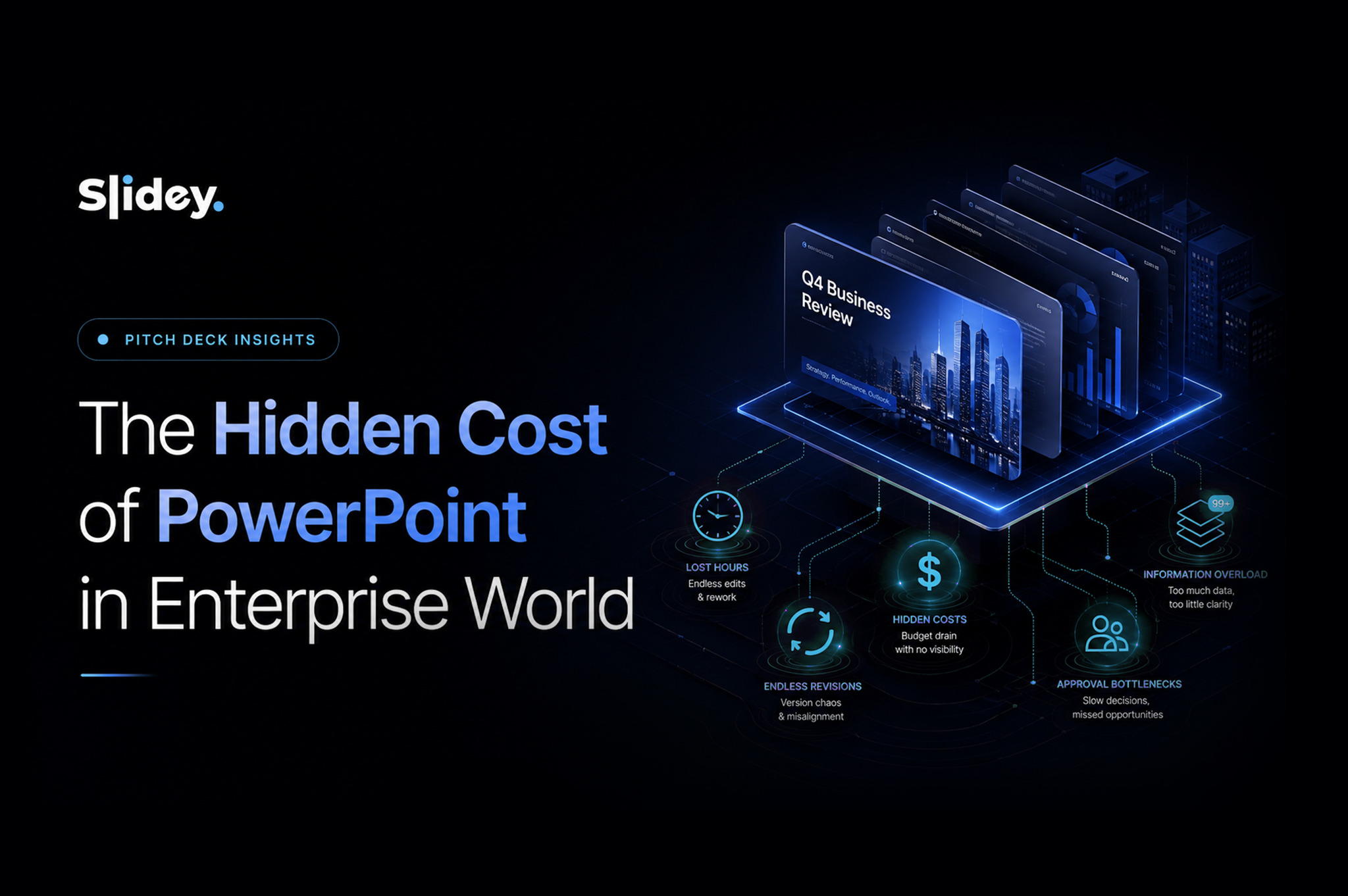
The Hidden Cost of PowerPoint in Enterprise World
Every week, each one spends 8 to 10 hours fixing presentations. Not leading. Not making strategic decisions. Just moving boxes, aligning charts, changing fonts, and updating slides.
Imagine this. Five executives, each earning roughly $250,000 a year.
Every week, each one spends 8 to 10 hours fixing presentations. Not leading. Not making strategic decisions. Just moving boxes, aligning charts, changing fonts, and updating slides.
Five executives. Ten hours a week. That is 50 executive hours lost every single week.
Over a year, that is roughly 2,600 executive hours. At about $125 per hour, that is more than $325,000 spent on presentation production instead of leadership.
That is more than one full year of leadership capacity, gone into slide formatting.
PowerPoint isn't expensive. Executive capacity is.
What the Real Cost of PowerPoint Actually Looks Like in the Enterprise
Most finance teams looking at software costs see a $12.99 monthly license and move on. That number is not the problem. The problem is the hidden cost of PowerPoint sitting inside your payroll.
A 2023 Forrester study found that knowledge workers spend an average of 4.1 hours per week creating or editing presentations. For a senior leader billing at $125 per hour, that is $512 per week per person. Multiply that across a leadership team of ten and you are looking at over $265,000 annually in PowerPoint productivity loss for enterprise teams before a single strategic hour is missed.
The real cost is not the software. It is the labour cost of who is producing slides and what they are not doing instead. Every hour an executive spends reformatting a deck is an hour not spent closing a deal, coaching a team, or making a decision that compounds over years.
This is an opportunity cost. In the context of PowerPoint, it is not abstract. It is calculable. It sits inside your existing payroll, invisible in your operating reports, and growing every quarter as slide complexity increases and leadership bandwidth stays flat.
The time wasted making PowerPoint slides does not show up as a line item. That is precisely why it keeps growing unchecked.
Why Executives End Up Doing Production Work Instead of Leadership
The root cause is structural, not behavioural. Most enterprises have never built a design infrastructure that scales properly alongside leadership demand.
When a board deck is due on Friday and the marketing team is already at capacity, the work falls to whoever is available. In most organisations, that person is the most senior one in the room. Not because they are the most skilled at slide design, but because they own the content and there is simply no one else to pass it to.
This is the enterprise presentation bottleneck in its most common form. It is not laziness or poor time management on anyone's part. It is a systems gap that consistently routes high-cost labour toward low-skill work without anyone noticing.
The $325,000 figure from the opening is not an extreme case. It is a conservative estimate based on five people and ten hours per week. In practice the problem is often much larger. Chief marketing officers rebuilding pitch decks the night before a client meeting. Chief financial officers manually update quarterly slides because the template breaks when real data is pasted in. Chief executives reformatting appendix slides at 11pm before a board presentation.
None of this appears in a productivity report. None of it triggers a budget alert. It simply happens, week after week, because the alternative has never been formally resourced by anyone.
The PowerPoint opportunity cost to the business is not just the hours lost. Across a typical enterprise leadership team, the executive hours consumed by slide production each week represent a recurring drain that compounds invisibly across every quarter. It is the decisions that did not get made, the conversations that did not happen, and the strategic thinking that was quietly displaced by slide formatting.
The Hidden Costs Beyond Executive Time
Time is the largest cost, but it is not the only one. There are four additional costs that most enterprises are absorbing silently every single quarter.
Brand inconsistency across departments
When every team builds their own slides without a shared system, clients and investors see a different deck from every function. Brand consistency in PowerPoint slides is not a cosmetic concern. It is a credibility concern. A fragmented visual identity signals internal disorganisation regardless of how strong the underlying content actually is.
Duplicated effort across teams
Without a centralised slide library, every team rebuilds the same slides from scratch. The company overview gets recreated twelve times across twelve departments. The market size chart gets reformatted every quarter by a different analyst. The time cost of this duplication is real and entirely avoidable with the right systems in place.
Data and compliance exposure
Sensitive financial figures, unreleased product roadmaps, and confidential client data regularly get pasted into PowerPoint files and emailed outside approved channels. Data leakage through PowerPoint presentations is a compliance risk that most legal and IT teams have never formally addressed because presentations are perceived as informal documents rather than data assets requiring proper governance.
Missed opportunities in high-stakes moments
A rushed, cluttered deck in a board meeting or investor pitch does not just reflect poorly on the team. It actively costs revenue. This is death by PowerPoint in its most commercially damaging form. A deck that fails to communicate the argument clearly can delay a funding decision, lose a client renewal, or undermine a strategic proposal that was sound on substance but completely invisible in presentation.
For corporate presentation design that addresses all four of these costs at the same time, the economics shift significantly in your favour.
How to Calculate What PowerPoint Is Really Costing Your Company
The formula is straightforward. Run your own numbers using this simple structure.
(Number of employees fixing decks) x (average hourly cost) x (weekly hours spent on slides) x 52 = Annual Hidden Cost
Using the opening example: 5 executives x $125 per hour x 10 hours per week x 52 weeks equals $325,000 per year. That cost per executive hour is not hypothetical. It is the rate your organisation is already paying, just not tracking against slide production specifically.
Now apply it to your own organisation. How many people in your leadership team touched a slide deck last week? How many hours did each one spend on it? What is their fully loaded hourly cost including salary, benefits, and overhead?
Most teams that run this calculation for the first time are genuinely surprised by the result. Not because the math is complex, but because the cost has never been made visible before. It has been absorbed into general leadership hours, categorised quietly as meeting preparation, and never isolated as a distinct operational expense worth examining.
The presentation production cost sitting inside your existing payroll is not a rounding error. For most enterprises with active sales, investor relations, or executive communication functions, it is a six-figure annual number that has never once appeared in a budget review.
Why Most Enterprises Cannot Fix This Internally

The standard internal responses to this problem tend to fail in very predictable ways.
Hiring one internal designer sounds completely logical until that designer becomes a bottleneck during earnings season, board prep, and major client pitches, all of which tend to happen at exactly the same time. One person simply cannot absorb the peak demand from a fifteen-person leadership team regardless of how talented they are.
Buying better software, whether that is a premium PowerPoint add-on, a Canva for Teams license, or a brand management platform, addresses the tool problem rather than the labour problem. Executives still have to personally operate the tool. The hours do not disappear just because the interface looks cleaner.
Issuing a new template and telling teams to use it consistently works for approximately one quarter. Without ongoing governance and dedicated design support, templates drift. Departments begin customising. The fragmentation quietly returns and the cycle starts again.
The in-house design capacity problem is fundamentally one of scale and specialisation. Presentation design at the enterprise level requires dedicated bandwidth, consistent brand governance, and the ability to absorb variable demand without creating new bottlenecks. None of those conditions exist reliably in a one-person internal design resource or a shared-services model originally built for print and marketing collateral.
The DIY presentation problem does not get solved by adding more tools. It gets solved by removing the production work entirely from the people who should never have been doing it.
What Slidey Does Differently: Giving Executive Teams Their Time Back

Slidey was built for one specific problem. Enterprise teams were spending executive hours on presentation production instead of leadership work, and that needed to change.
The service is not designed to make presentations prettier. It is designed to have presentation production offloaded from executive schedules entirely. The direct result is recovered executive productivity, returning that time to the decisions, conversations, and strategy work that actually justifies senior compensation in the first place.
When the $325,000 annual cost is framed as the alternative, the economics of ongoing presentation support become completely straightforward. The question is not whether a presentation partner costs money. The question is whether it costs less than the leadership capacity currently being consumed by slide formatting every single week.
For most enterprise teams, the answer becomes clear before the first conversation ends.
A Quick Gut-Check for Your Own Team

Before moving on, run three honest questions against your own organisation.
Who in your leadership team actually touched a slide deck last week? Not reviewed one. Actually built or reformatted slides from scratch.
How many hours did that take across all the people who were involved in the process?
What would those hours have been worth if they had been spent on the work those people are genuinely hired to do?
If the answers make you uncomfortable, that discomfort is the hidden cost of PowerPoint finally making itself visible. The calculation was always sitting there. Most organisations simply never chose to run it.
Conclusion
PowerPoint isn't expensive. Executive capacity is. That line is worth sitting with before the next board deck lands on a senior leader's desk late at night.
The cost of presentation production in most enterprises is not hidden because it is small. It is hidden because it has simply never been measured or questioned. Once you actually run the formula, the number tends to be large enough to justify a completely different approach immediately.
If your leadership team is ready to stop absorbing that cost internally, talk to our team to see what reclaiming that time looks like in practice.


.svg)